The Bottom Line - Banking on Community Impact

August 28, 2026
Strong banks and strong communities grow together
Banking is a numbers business. And we pay close attention to deposits, loans, assets, and financial performance.
But another measure of success matters just as much: the difference we make in the communities we serve.
That is one reason community banking and community impact go hand in hand. When you live and work in a community, you get to know its people, its businesses, and the organizations working every day to make life better. You also build trust by listening and learning where help can make the greatest difference.
Trust then grows by showing up and staying involved over time. That trust and commitment to showing up were important to Country Club Bank, and that commitment continues to build as we become FNBO. That is why community investment and employee volunteerism are so important. They help explain who we are and the kind of impact we want to make.
We also thought it would be helpful to share a glimpse of the criteria FNBO uses for giving decisions. FNBO focuses its community investment in three areas closely connected to our work as a bank: affordable housing, financial literacy, and workforce development.
Why these three?
Each contributes to greater financial stability and confidence. And when individuals and families are more confident about their futures, communities are better positioned to grow and thrive.
This month, FNBO is announcing a $500,000 investment in the Kansas City community. That includes $350,000 in Impact Grants awarded to 14 area organizations, and a separate $150,000 contribution to Inclusion Connections’ BelongKC Capital Campaign. These funds are in addition to the hundreds of thousands of dollars we contribute annually to support community impact.
You probably recognize many of the Impact Grant recipients, including Great Jobs KC, Inclusion Connections, Habitat for Humanity, Build WyCo, Literacy KC, IC Stars, InCircle, Catholic Charities of Northeast Kansas, The Mission Project, Catholic Charities of Kansas City–St. Joseph, Pawsperity, Junior Achievement, Life Unlimited, and High Aspirations.
These organizations address community needs in different ways. Some prepare people for meaningful employment. Others improve access to housing, strengthen financial knowledge, or help individuals live more independently. What they share is the ability to create meaningful, measurable impact on our communities.
We strive to be thoughtful and structured in our approach by designating FNBO City Ambassadors, a group of FNBO associates who stay closely involved in identifying needs, evaluating organizations, and helping determine where our resources can make the greatest difference. Additionally, FNBO’s dedicated philanthropic team adds experience, discipline, and support to that local knowledge.
Personally, as one of the City Ambassadors for Kansas City, I see my role as understanding what our community needs, listening to the organizations doing the work, and connecting the bank’s resources with opportunities to make a lasting difference.
Of course, financial contributions are only part of that partnership. Our employees volunteer, serve on boards, support events, and work alongside nonprofits throughout the Kansas City area. That involvement helps us better understand the challenges organizations face and the people they serve.
Community banking has always been about more than transactions. It’s about building relationships, showing up, and doing our part for the places we call home. Thank you for your continued trust and support, and for helping us invest in stronger communities for all of us.
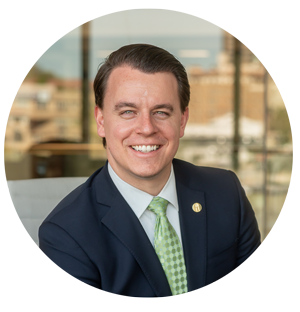
— Collin Thompson, CPA, Director, Community Banking, City Ambassador, Country Club Bank, a division of FNBO, Member FDIC
Economic Insights
Preparing for what's next
The broad stock market changed little in July, but that relative calm concealed considerable volatility beneath the surface.
Semiconductor stocks, which had just completed their strongest quarter on record, fell sharply before recovering late in the month. The Nasdaq Composite posted its worst July in 22 years, despite July historically being one of its stronger months. Bonds also declined modestly as long-term interest rates rose, while higher oil prices helped commodities gain nearly 8%.
These crosscurrents offer an important reminder: Headline market indexes do not always tell the full story.
One defining feature of today’s market is the growing influence of semiconductors. Computer chips power everything from smartphones and automobiles to medical equipment, cloud computing, and artificial intelligence. Every AI search, data center, and advanced computing application depends on them.
As spending on AI infrastructure has increased, semiconductor stocks have become both market leaders and a major source of volatility. The PHLX Semiconductor Index gained approximately 75% during the second quarter. Even after falling nearly 30% from its June peak at one point in July, semiconductor stocks remained roughly twice as high as a year earlier.
The industry now represents nearly 20% of the S&P 500, up from approximately 6% five years ago. That concentration means semiconductor exposure can significantly influence whether an investment portfolio outperforms or underperforms the broader market.
History encourages some caution. Since the early 1980s, semiconductor stocks have outperformed the S&P 500 by more than 200 percentage points over a two-year period only eight times. In nearly every instance, the industry subsequently experienced a period of meaningful underperformance.
That does not mean the current AI expansion is about to end. It means expectations are high, market leadership is concentrated, and diversification remains important.
Business investment in AI-related data centers, energy infrastructure, semiconductor manufacturing, and reshoring has also become a significant engine of economic growth. This is potentially encouraging because business investment can expand the economy’s productive capacity and support future productivity gains.
Consumers, however, remain the foundation of the U.S. economy. Consumer spending accounts for roughly two-thirds of economic activity, and sustained business growth ultimately depends on households continuing to spend.
Consumers still have important sources of support. Unemployment remains historically low, wage growth continues to exceed longer-term inflation expectations, and household net worth is near record levels. Americans over age 55, who own most financial assets, also account for nearly half of consumer spending.
But consumers are not invincible. Energy prices are approximately 30% higher than a year ago, mortgage rates remain elevated, and inflation-adjusted consumer-spending growth has been losing momentum. Higher borrowing costs and everyday expenses could eventually make households more cautious.
Political uncertainty may add another layer of volatility. Historically, the three months preceding midterm elections have been a weaker seasonal period for stocks, with below-average returns and above-average volatility. Markets often improve after elections as uncertainty around taxes, regulation, spending, and trade policies fade.
The lesson is not to predict election outcomes or reposition portfolios around political headlines. It is to recognize that uncertainty can create short-term swings without changing long-term investment principles.
Bottom Line: Investors should watch three interconnected forces in the months ahead: semiconductor and AI investment, consumer resilience, and election-related uncertainty. Each could influence the direction of the economy and markets, but none can be forecast with complete confidence.
That is why investors should avoid making decisions through the rearview mirror. Recent winners do not lead forever, market leadership changes, and periods of volatility are inevitable. Rather than chasing yesterday’s performance or trying to anticipate every headline, investors are generally better served by maintaining diversified portfolios designed to adapt to whatever comes next.
Invest well. Be well.

— Rusty Vanneman, CFA®, CMT®, Chief Investment Officer (CIO), FNBO Wealth
CFA® and Chartered Financial Analyst® are registered trademarks owned by CFA Institute. The Chartered Market Technicians Association (CMT Association) owns the certification marks CMT® and CHARTERED MARKET TECHNICIAN®, which it authorizes use of by individuals who have completed the CMT Association’s initial and ongoing certification requirements.
The opinions and views expressed herein are those of the author and do not necessarily reflect those of Country Club Trust Company, a division of First National Bank of Omaha (FNBO), or any affiliate thereof. Information provided is for illustrative and discussion purposes only, should not be considered a recommendation, and is subject to change. Some information provided above may be obtained from outside sources believed to be reliable, but no representation is made as to its accuracy or completeness.
Please note that investments involve risk, and that past performance does not guarantee future results. Investment products are not insured by FDIC/other federal agencies; are not deposits of/nor guaranteed by the Bank or any of its subsidiaries/affiliates; and may lose value.
Partnership Profile
Inclusion Connections: Building a place to live, work, and belong
 Nearly 30 years ago, when Debbie Horn’s son Matthew was born with Down syndrome, she naturally began asking questions she had never considered before.
What would his education look like? What would happen after high school? Would he have opportunities to work, build friendships, and one day live in a place of his own?
Those questions would eventually become the inspiration for Inclusion Connections and a mission that now serves families throughout the Kansas City community.
“I realized early that I needed to be an advocate for Matthew, and at the same time, I realized other families probably had the same questions and concerns that I did,” Horn said. “If I was struggling to figure out how to help him get the best education and opportunities possible, I knew many other families were struggling, too.”
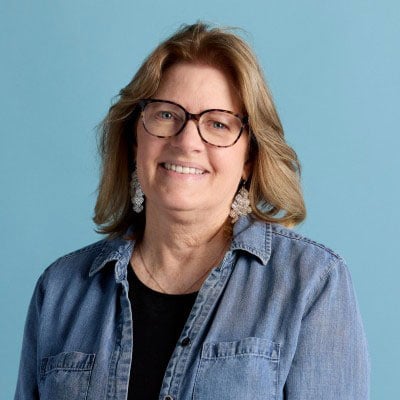 Horn began learning, advocating, and organizing activities for families raising children with developmental disabilities. As Matthew approached high school graduation, one question became increasingly urgent: What next?
Most of his classmates would move on to college, work, and independent lives. Matthew wanted those same opportunities.
“He would say, ‘I want to work. I want to do what my brothers are doing,’” Horn said.
That statement inspired Horn to establish Inclusion Connections, an Olathe nonprofit that helps young people with developmental disabilities continue learning, develop friendships, find employment, and become more independent.
Its employment program, PawsAbilities, runs a business that produces and sells handcrafted pet treats and products. Participants learn practical skills by making dough, operating equipment, packaging products, filling online orders, and serving customers.
Those experiences build both skills and confidence. Inclusion Connections also helps participants find community-based jobs matched to their interests and abilities and provides continuing transportation and job coaching.
The organization currently supports about 100 community-based jobs, with more than 95% of participants continuing successfully in the positions found for them.
Matthew is among those success stories. He now works more than 30 hours each week across three jobs, making street-sweeper brushes, working at SPIN! Pizza, and assisting in an insurance office.
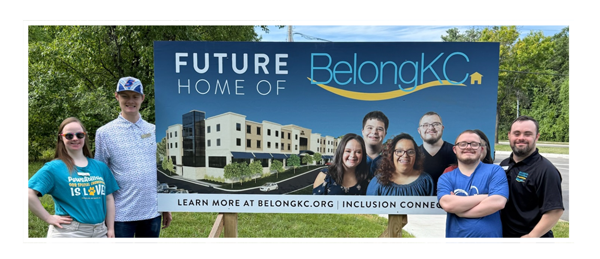
Horn’s next vision is BelongKC, an affordable supportive-living community designed for adults with intellectual and developmental disabilities. Planned for a site in Olathe, BelongKC will include 41 apartments, plus a dining hall, theater, gym, art room, and other spaces where residents can gather, learn, and grow.
Horn has already received approximately 200 applications for the 41 apartments.
“It’s a parent’s dream,” Horn said. “It will be safe, friendly, and productive for the residents who live there, and also give them the independence they want to lead independent lives.”
FNBO recently awarded Inclusion Connections a $150,000 donation through the First National Bank Fund to support the BelongKC Capital Campaign.
The contribution continues a relationship that dates to Inclusion Connections’ beginning, when the organization established its primary operating account with FNBO.
FNBO has provided grant support for PawsAbilities over the last eight years. Country Club Bank associates have also volunteered, supported the organization’s FashionAbility gala, and participated in its Top Model fundraising competition.
“We’ve been working with FNBO and Country Club Bank for a long time,” Horn said. “We’re thrilled about this award and grateful for their ongoing support. It means a great deal to know they believe in what we’re building and the people it will serve.”
For Horn, BelongKC is another success story born from the questions she began asking nearly 30 years ago. With FNBO’s support, Matthew and many others are one step closer to having a place of their own: a community where they can live with greater independence, pursue their goals, and know they truly belong.
Insurance Solutions
FNIC: Protect what you’ve built with clear direction, honest advice, and smart protection
 You’ve worked hard to build your business. Protecting it takes more than purchasing policies.
It means understanding the risks you face, preparing for the unexpected, and having an experienced advisor you can call when questions arise.
With the acquisition of Country Club Bank, a division of FNBO, you now have a convenient connection to FNIC, a full-service insurance and risk management firm. FNIC has served businesses for over 100 years and shares ownership with FNBO.
FNIC approaches insurance as a long-term advisory relationship. Its insurance professionals take time to understand how your business operates and where you want to go. Using a detailed risk-mapping process, they examine your operations and existing coverage, identify potential gaps, and explain what those gaps could mean.
That guidance sometimes includes telling business owners that their current coverage is working well and no change is necessary.
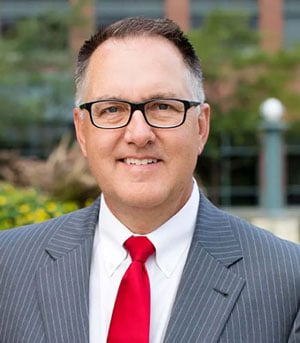 “We see ourselves as partners in helping clients navigate risk,” said Scott Hill, president of FNIC. “Our goal is to understand your business, educate you on risks, and then help you make informed decisions.”
That relationship also continues after coverage is placed. While FNIC clients have access to an entire service team, the advisor who initiated the relationship remains involved and available as needed.
FNIC can support your business in three primary areas:
- Commercial insurance protects your property, operations, and financial future, with capabilities ranging from traditional property and casualty coverage to cyber insurance, captives, and alternative risk solutions.
- Employee benefits help you attract, retain, and care for your people through thoughtful benefit strategies, compliance guidance, and year-round service.
- Surety bonds help you pursue projects and meet contractual requirements with responsive support, experienced guidance and strong carrier relationships.
FNIC is the nation’s 55th-largest insurance brokerage and second-largest bank-owned firm, with more than 330 employees serving clients across the Midwest. Last year, the firm placed more than $1 billion in written premiums.
FNIC operates independently, but its advisors work closely with FNBO bankers. That means your banker can introduce you to an insurance professional who brings the same approach to accessibility, responsiveness, and trusted relationships.
If your business has grown, changed, or you simply haven’t reviewed your coverage recently, now may be a good time to take another look. Contact your banker today, or visit FNIC to connect with an advisor.
Insurance products and services are offered through First Insurance Group, LLC (FNIC), a non-bank affiliate of FNBO. FNIC is not FDIC insured.